
What is the Essential Economy?
The Essential Economy is the set of industries that build, power, move, maintain, and serve the physical world. It includes construction, energy, facilities and services, fleet management, food and beverage, government, healthcare, maintenance and mechanics, property management, quick service restaurants, rental car and transportation, and retail.
Together, these industries account for roughly 50% of US GDP — about $12 trillion — and employ approximately 95 million people. They produce the goods and services that everyone else depends on. Despite a decade of technological progress in the broader economy, productivity growth inside the Essential Economy has been flat — and in some sub-sectors, has declined.
Last updated: [Date]. Sourced from US Bureau of Labor Statistics and Bureau of Economic Analysis. See Sources, below.
Three numbers worth memorizing.
$12T
US GDP generated by the Essential Economy
Roughly 50% of total US GDP. Source: BEA industry GDP data, BLS occupational data.
95M
US jobs across the 12 industries Array serves
More than half of the US workforce. Frontline, hourly, often invisible to corporate technology investment. Source: BLS sector employment data, Array analysis.
~0%
Productivity growth over the last decade
While the knowledge economy compounded, the Essential Economy stalled. In some sub-sectors, productivity declined. Source: BLS Productivity & Costs program.
The twelve industries that build, power, move, maintain, and serve the physical world.
These are the industry categories Array operates in. Each has its own talent dynamics, productivity challenges, and wage structures — but all share the same core problem: work measured by hours, not output. Each industry below links to the dedicated Array vertical page for that segment, where the workforce dynamics, case studies, and operational details live.

~8.3M jobs
(BLS, NAICS 23, 2024)
Building and repairing the homes, roads, commercial structures, and infrastructure the country runs on.

~6.0M jobs
(BLS, NAICS 21+22, 2024)
Generating, refining, and distributing the power that runs every other industry — from utilities to oil and gas to renewables.

~3.5M jobs
(BLS, building & grounds occupations, 2024)
Cleaning, maintaining, and operating the commercial buildings, campuses, and facilities the rest of the economy works in.

~3.7M jobs
(BLS, transportation managers + heavy/tractor-trailer drivers, 2024)
Managing and operating commercial vehicle fleets — delivery, distribution, service, and corporate.

~12.4M jobs
(BLS, NAICS 722 food services, 2024)
Producing, processing, distributing, and serving the food and beverages consumed across the country.

~23M jobs
(BLS, federal + state + local government, 2024)
Public-sector frontline operations — federal, state, and local — that keep civic infrastructure running.

~22M jobs
(BLS, NAICS 62, 2024)
Delivering frontline patient care and the operational and support roles that make care delivery possible.

~6.4M jobs
(BLS, installation/maintenance/repair occupations, 2024)
Keeping vehicles, equipment, machinery, and infrastructure running across every other Essential Economy industry.

~2.5M jobs
(BLS, NAICS 53 real estate + rental/leasing, 2024)
Operating and maintaining residential, commercial, and industrial real estate at scale.

~5.5M jobs
(BLS, NAICS 7225 limited-service restaurants, 2024)
Operating high-volume, fast-paced restaurant concepts where speed and consistency are the product.

~6.5M jobs
(BLS, NAICS 48–49 partial, 2024)
Moving people and goods — rental car operations, ground transportation, logistics, and distribution.

Why a decade of innovation hasn't moved the needle.
The knowledge economy has compounded for decades. The Essential Economy hasn't. The reason is structural — and it explains why every workforce technology rollout in this market has fallen short of its promise.
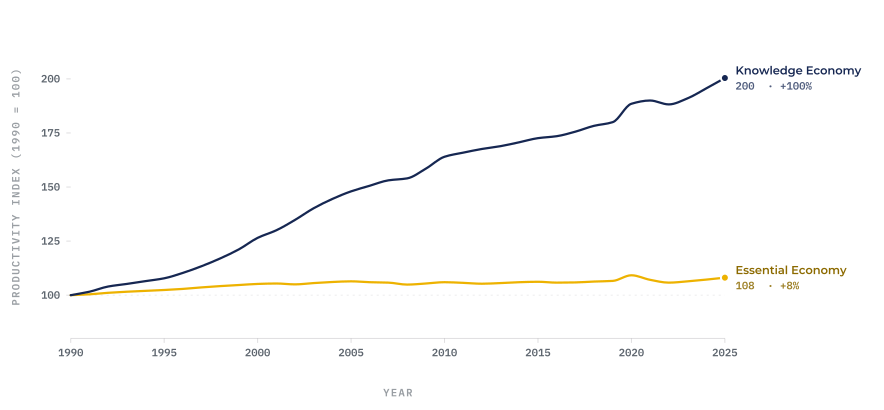
Three reasons this market has been hard to fix:

Hours have always been the unit:
Wages have been priced against time, not output. That assumption has been hard-coded into payroll, scheduling, and management systems for over a century. It hides individual productivity differences and removes the incentive to find or develop higher-output workers.

The math has discouraged investment:
Tech, management, and insurance costs as a percentage of labor scale inversely with wage. A $5,000-per-year tech stack is rational for a $150K knowledge worker. It is irrational for a frontline worker earning $30K who turns over within six months. So the investment never happens.

Capturing individual output data has been expensive:
The Essential Economy is physical work — work in motion, work distributed across locations, work without a screen. Instrumenting it requires investment that, until recently, didn't pencil. As a result, no one has built a full picture of how individual output varies, even though it varies enormously.
Until those three things change, productivity stays where it is. Array exists because we believe all three can change — and have started to.
The largest unsolved productivity problem in the US economy.
The Essential Economy is half of US GDP and a majority of the US workforce.
If productivity in this segment grew at even half the rate of the knowledge economy over the next decade, the impact would be measured in trillions of dollars — distributed across the businesses that run our supply chains, our hospitals, our power grids, our cities, our restaurants, and our retail floors.
Most of the public conversation about workforce productivity right now focuses on AI replacing knowledge workers.
That conversation skips past the Essential Economy entirely. Humanoid robots are decades away from production deployment. Generative AI doesn't drive a forklift, prep a rental car, fill a prescription, or close a service ticket on an HVAC unit.
The productivity gains that are available in the Essential Economy don't come from replacing people.
They come from measuring work properly for the first time. They come from identifying the workers who are already producing more, and learning what makes them effective. They come from coordinating execution at the point of work, with real-time visibility into what's actually happening on the floor.

The story of the next decade isn't AI replacing the frontline.
It's the Essential Economy finally being measured — and managed — like the trillion-dollar machine it is.
Four economic laws frame how Array reads this market.
These aren't slogans. They are the economic premises Array operates on — the assumptions about how labor, productivity, and value actually work. We've published them so they can be argued with.
Labor cost efficiency is the metric that matters.
Real outputs divided by total labor compensation. This is the relationship businesses should be optimizing — not labor cost in isolation, and not headcount in isolation. Today's market treats labor as a cost line item. We treat it as the ratio that determines whether an operation works.
Real outputs are the sum of individual outputs — and they vary enormously.
Most companies don't measure output at the individual level. When they do, they assume workers are roughly equivalent. Both assumptions are wrong. Variance between workers is large, persistent, and measurable. It is the most important and most ignored fact in workforce economics.
Efficient labor markets price to outputs, not hours.
Wages priced against time mask the productivity differences between workers. Markets that price to output reward higher performers, surface mispriced talent, and align incentives correctly. Almost no labor market does this today. The gap between current pricing and correct pricing is the arbitrage.
Tech spend on talent scales inversely with wage.
Companies spend a meaningful percentage of total comp on tech, management, and insurance for high-wage workers. They spend almost nothing on those things for frontline workers. That is rational under current economics — and it is the reason the Essential Economy has been technologically underserved for decades. Changing it requires a different cost structure, not a different intention.
Frequently asked questions
The vocabulary of measurable work.
Array uses specific terms with specific meanings. These are the ones that matter — defined plainly, updated when the thinking sharpens, and citable by anyone trying to understand this market.
Sources
Statistics on this page are sourced primarily from US federal data and Array's internal analysis.
Last reviewed: [Date].
